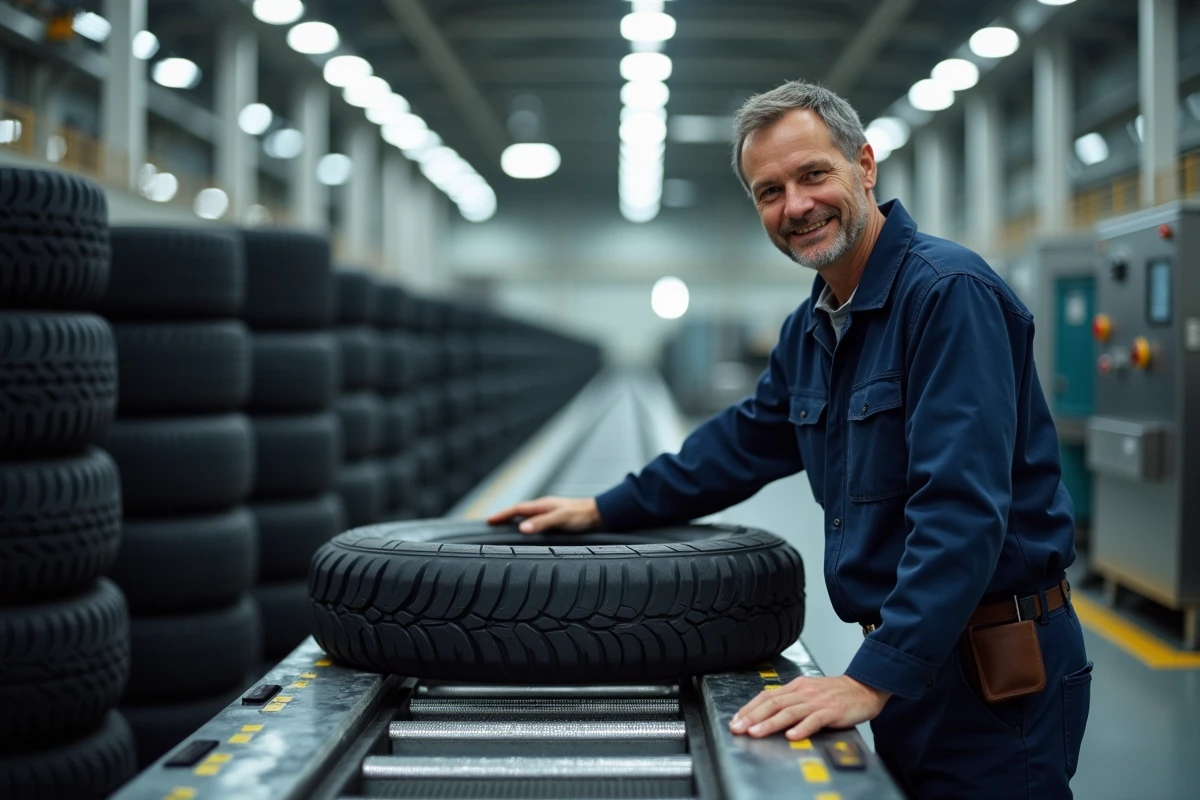
Kleber tire ses racines de l’idée reçue selon laquelle toutes ses tire factories are located in France. The brand, owned by the Michelin group since 1981, organizes its production across several European countries, including Poland and Serbia, in addition to its historical French sites.
Manufacturing a Kleber tire involves orchestrating a series of precise steps: meticulous mixing of ingredients, calibrated cuts, and millimeter-perfect assemblies. At each phase, scrupulous quality controls ensure everything is up to standard. This careful operating method allows the brand to offer consistent and reliable performance, regardless of the production site.
Kleber, a French brand at the heart of the Michelin group: history and identity
Kleber was born in 1910 in Colombes, near Paris, a French industrial hub. At that time, it was called “Société Française B. F. Goodrich.” The name Kleber was adopted in 1945, a nod to the Paris avenue where the headquarters was located. Since then, the brand has cultivated an identity forged on the robustness of its tires and a constant desire to innovate for European drivers.
The year 1981 marked a turning point: Kleber joined the Michelin family. A new chapter opened. The brand then benefited from the expertise and industrial power of the Clermont-based giant, without losing its identity. It remains focused on being accessible, reassuring, and practical, values that are reflected in its campaigns and the image it projects.
Looking into where Kleber tires are manufactured helps to understand this uniqueness. While the roots are French, production now extends across Europe. However, the quality requirement is non-negotiable. For detailed insights into these industrial challenges, the article “Origin of Kleber Tires: Where and How Are They Made? – Voiture Valk” provides concrete answers. At Kleber, history is not frozen in the past: it is built daily, in every factory, on every road traveled, driven by industry developments and the expectations of motorists.
Where are Kleber tires actually manufactured? An overview of production sites
The map of Kleber’s production sites speaks volumes about its strategy: anchoring its strengths in France while relying on a solid European network. Two French factories stand out particularly for their specialization and history.
The Troyes factory (Aube) plays a central role in the setup. There, tires for cars and light commercial vehicles are manufactured, a recognized expertise in the region. In Montceau-les-Mines (Saône-et-Loire), agricultural tires take center stage. This site, strategic for the brand, illustrates the desire to maintain a strong industrial base on national territory while adhering to the high standards of the Michelin group.
But Kleber is not limited to France. Several complementary units in Europe take over for the assembly of specific models. This flexible organization allows for quick adjustments in production according to market needs while optimizing logistics. The proximity between different sites simplifies the tracking of materials, particularly for rubber and other components that contribute to the quality of the finished tire.
Here is an overview of the main factories and their specialties:
- Troyes (Aube): manufacturing of tourism and utility tires
- Montceau-les-Mines (Saône-et-Loire): agricultural tires
This industrial network, from the manufacturing site to the distribution center, is built on decades of expertise and a culture of innovation, both French and at the European level.

From material mixing to final inspection: immersion in the manufacturing process of Kleber tires
Behind every Kleber tire, everything begins with the selection of materials. Natural and synthetic rubber, silica, reinforcing additives: each ingredient is chosen and measured precisely to ensure the rolling resistance and expected lifespan. Once the mix is ready, it moves to extrusion: the strips that will form the different parts of the tire are then shaped.
Next comes assembly. The textile layers, steel beads, belts, each element finds its place according to a rigorous sequence. The operators’ movements, combined with the precision of the machines, give birth to the tire carcass. Everything then goes into a heated press: vulcanization fixes the structure, defines the grooves, and gives the tire its road characteristics.
At each stage, vigilance is key. Enhanced controls punctuate the chain: dimension checks, X-ray examinations, balancing tests, visual inspections… Everything is scrutinized before being approved, in accordance with European standards. This protocol applies equally to tourism tires and agricultural models designed in Montceau-les-Mines. With this level of demand, Kleber cultivates a production where innovation and safety go hand in hand.
With each factory exit, a Kleber tire carries the trace of this controlled journey, from the choice of raw materials to the final checks. It is on the asphalt, over the kilometers, that this discreet expertise becomes evident.