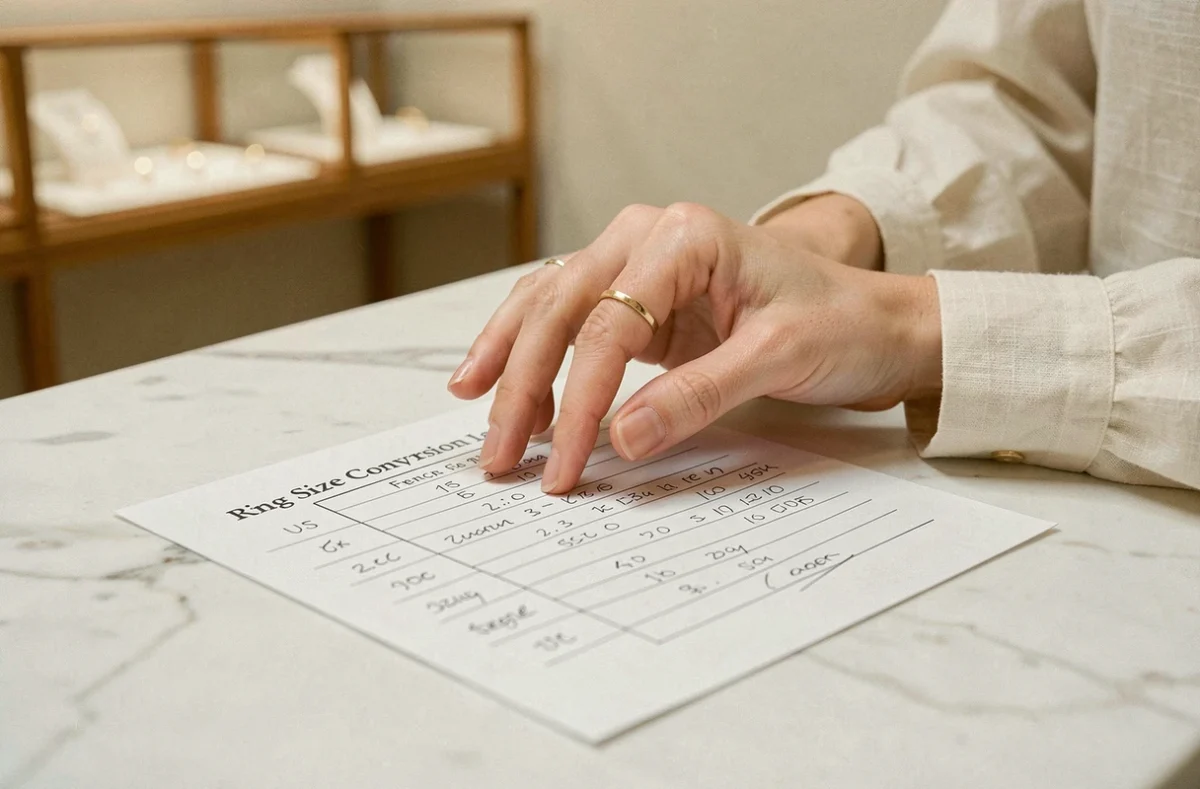
The French ring size corresponds to the inner circumference of the ring expressed in millimeters. A size 52 ring therefore measures 52 mm in inner circumference. The American system, on the other hand, uses its own numerical scale (4, 5, 6, 7…) with no direct link to a metric unit. Switching from one system to another without a reliable chart exposes one to ordering errors, especially when making an online purchase from a foreign site.
Why US and French ring sizes do not convert by simple calculation
The French system follows a linear logic: each size increases by one millimeter in circumference. From 48 to 49, then from 49 to 50, the gap remains constant.
The American system works differently. Sizes progress in irregular increments, often by quarters or half-sizes (6, 6.25, 6.5, 6.75, 7). Each US half-size does not always correspond to a fixed gap in millimeters.
This discrepancy explains why a single conversion formula does not work reliably. Depending on the charts consulted, the same US size may be associated with two neighboring French sizes. One guide will indicate that a 6 US is equivalent to 52, while another will show 51.5.
These discrepancies arise from the rounding applied by each manufacturer. The only stable reference remains the measurement in millimeters of the finger’s circumference, which can then be used to find the size in each system via a conversion chart. To obtain the correspondence of US and French ring sizes, this physical measurement is the safest starting point.
Conversion chart from French to US ring sizes
The table below groups the most common sizes. The central column indicates the inner diameter in millimeters, which serves as a bridge between the two systems.
| Size FR | Inner diameter (mm) | Size US |
|---|---|---|
| 48 | 15.3 | 4.5 |
| 50 | 15.9 | 5.5 |
| 52 | 16.6 | 6 |
| 54 | 17.2 | 6.75 |
| 56 | 17.8 | 7.5 |
| 58 | 18.5 | 8.25 |
| 60 | 19.1 | 9 |
| 62 | 19.8 | 10 |
When a size falls between two US values (for example, between 6 and 6.5), the most cautious rule is to choose the next half-size up rather than the lower size.

Measuring your finger: the method that limits errors
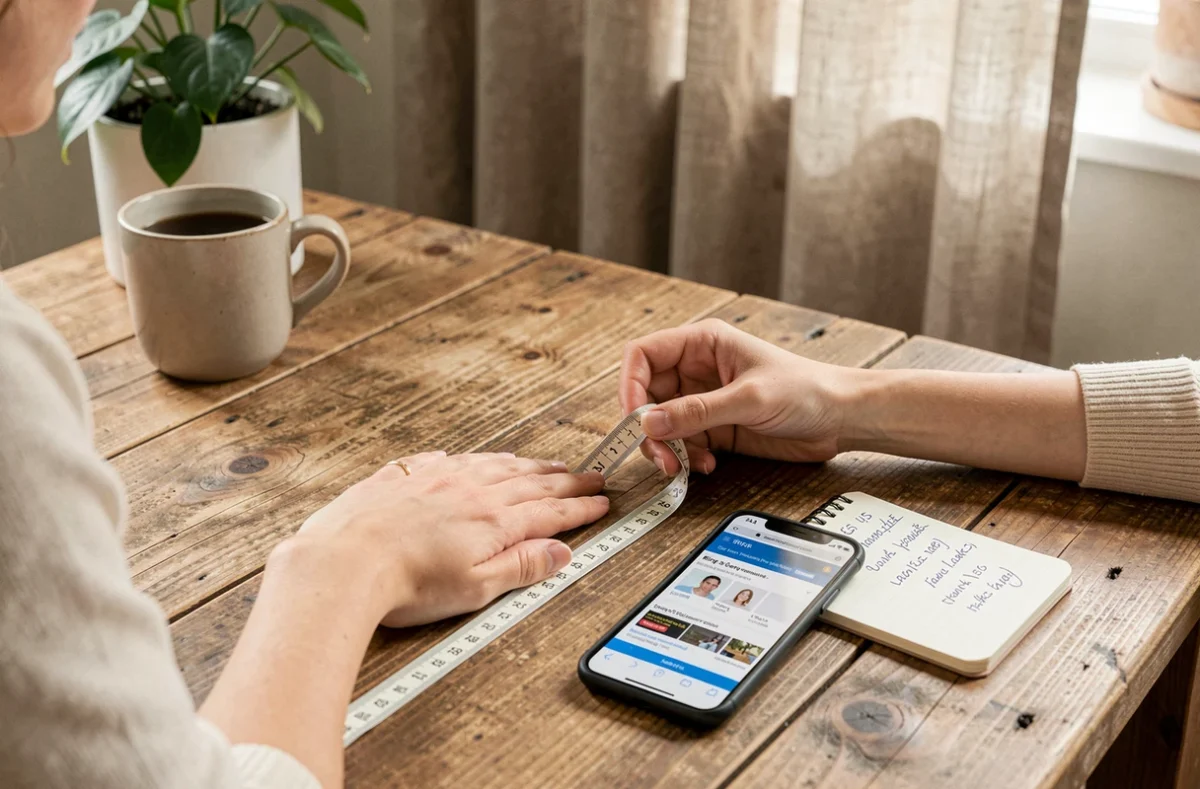
The professional metal ring sizer remains the most reliable technique. Jewelry stores offer them for free. For a measurement at home, a strip of paper and a ruler are sufficient.
- Wrap a strip of paper (or a non-elastic thread) around the base of the concerned finger, without tightening excessively or leaving any slack
- Mark the overlapping point with a pen, then measure the length obtained in millimeters with a ruler
- Transfer this measurement to the “Size FR” column of the table (the circumference in millimeters directly corresponds to the French size)
- If the finger has a knuckle wider than its base, also measure at the knuckle and retain an intermediate size between the two measurements
The timing of the measurement matters. Fingers swell at the end of the day and in warm weather, and retract in the morning or after exposure to cold. For a representative result, measure in the middle of the day at normal room temperature.
Measuring from an existing ring
Place a well-fitting ring on a sheet and trace the inner contour with a fine pencil. Measure the diameter of the resulting circle in millimeters. Multiply this diameter by 3.14 to find the circumference, thus the French size.
This method is useful for preparing a surprise: discreetly borrowing a ring regularly worn by the person is enough to obtain a usable measurement.
Ring width and size choice: an often overlooked parameter
A wide ring (starting from about 6 mm) exerts more pressure on the finger than a thin band. The contact with the skin is spread over a larger surface, creating a heightened sensation of tightness even at the same size.
For a wide wedding band or a signet ring type, considering a half-size above the usual measurement improves daily comfort. This is not an absolute rule: the shape of the finger, the shape of the ring (domed, flat) and the material also play a role.
Resizing after purchase remains possible on most metals (gold, silver, platinum), but some alloys or rings set all around cannot be resized. Checking this possibility before ordering avoids an unpleasant surprise.
Reliability of online size guides: what varies from site to site
Conversion tables published on jewelry websites are not standardized. The same inner diameter may be associated with slightly different US sizes depending on the source. These discrepancies are generally less than half a size, but they are enough for a ring to be tight or loose.
The most reliable method for ordering from abroad:
- Measure the circumference of the finger in millimeters (not in sizes)
- Consult the size guide specific to the seller from whom the order will be placed, not a generic table found elsewhere
- Compare with a second table to spot any inconsistencies
Each brand may apply its own rounding. A size 52 from a French manufacturer may not necessarily fall on the exact same millimeter as a 6 US from an American jeweler. The millimeter measured on the finger remains the only universal data.
The choice of the right size relies on a physical measurement, not on an approximate conversion. Taking thirty seconds to wrap a thread around the finger and report the result in millimeters makes the entire conversion process between US and French sizes perfectly predictable.