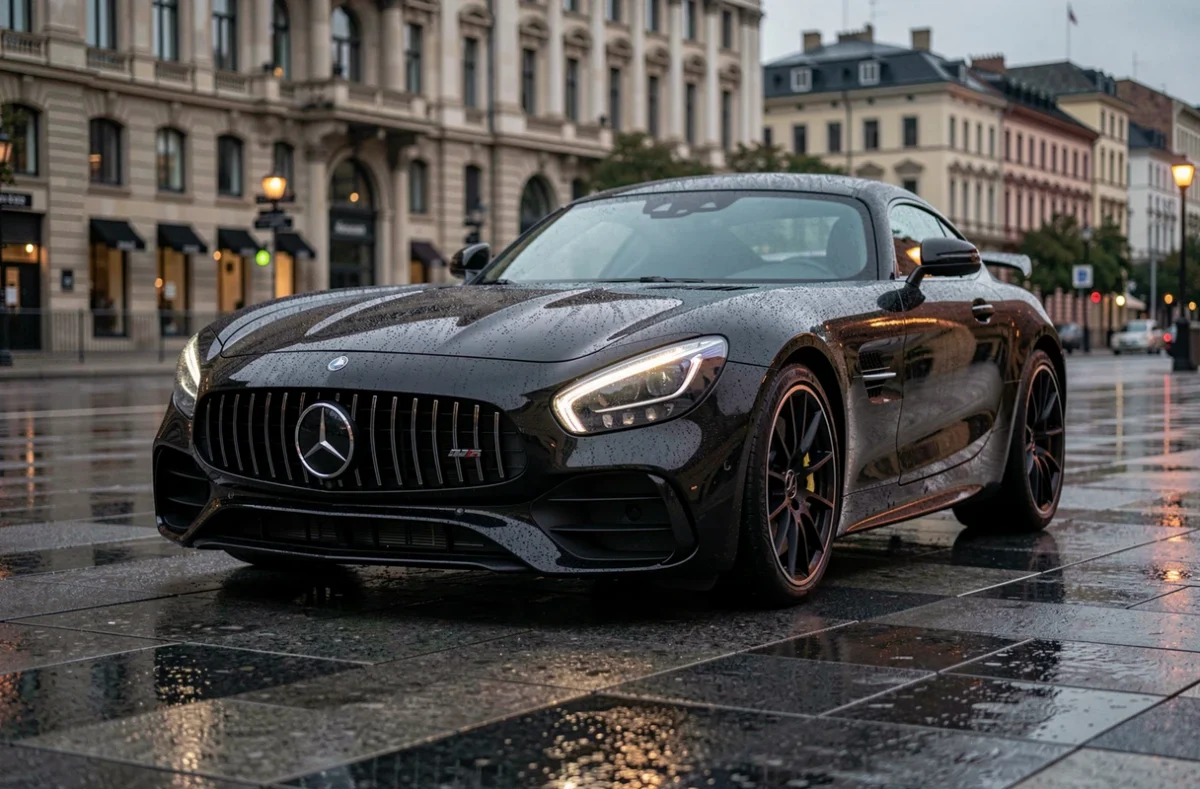
Three letters are enough to transform a standard Mercedes-Benz into a performance machine: AMG. Born in an engine preparation workshop in the late 1960s, this sports division built its reputation on competition before becoming a wholly-owned subsidiary of the Stuttgart manufacturer. Today, the range includes sedans, SUVs, coupes, convertibles, and even electric models, with a manufacturing philosophy that remains unique in the automotive industry.
Foundation of AMG and early competitive achievements
The story begins in 1967, when two engineers, Hans Werner Aufrecht and Erhard Melcher, create a structure dedicated to preparing racing engines in Großaspach, Germany. The acronym AMG combines their initials and the name of the town: Aufrecht, Melcher, Großaspach.
The turning point comes in 1971 at the 24 Hours of Spa. The 300 SEL 6.8 AMG, nicknamed “Red Pig,” finishes second in the race. A heavy and unlikely sedan on an endurance circuit, it establishes the name AMG in the European motorsport scene.
The following decades see AMG expand its activities: preparation of production models, development of specific engines, and a gradual rapprochement with Daimler-Benz. This transition from an independent workshop to an integrated division has allowed AMG to access the industrial resources of the group while maintaining its manufacturing methods.
To learn everything about AMG at Mercedes, one must understand this journey: each step, from the artisanal workshop to the subsidiary, has shaped the technical identity that the brand still claims.
Principle “One Man, One Engine”: what this method concretely changes
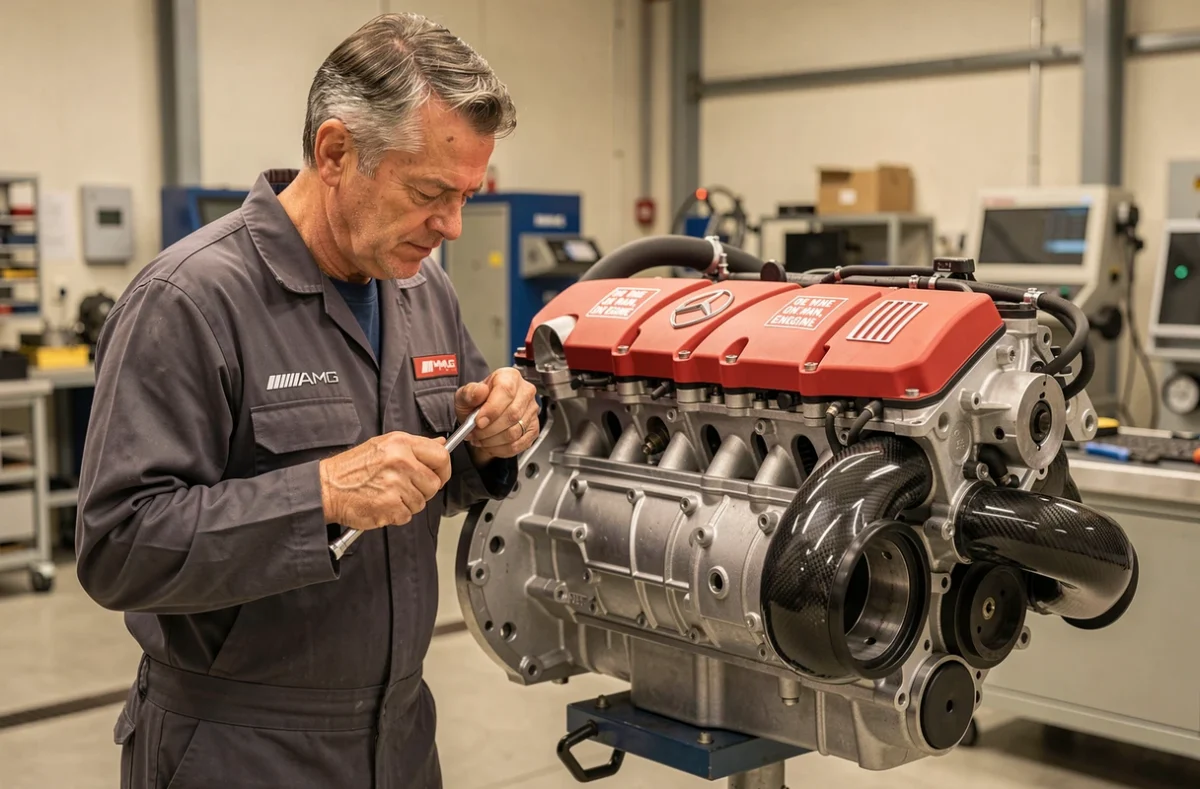
Most manufacturers assemble their engines on automated lines. At AMG, a single technician manually assembles each engine from start to finish. This principle, summarized by the phrase “One Man, One Engine”, is not a marketing argument without consequence.
The mechanic affixes their signed plaque on the engine block. This gesture commits their responsibility for the entire assembly process: adjusting tolerances, checking torque values, inspecting internal components. Traceability is complete.
This manufacturing method comes at a cost. The assembly time for an AMG engine far exceeds that of a production engine made on a line. The question this method raises is about its sustainability in the face of the increasing electrification of the range, as an electric motor does not require the same manual assembly work.
Current Mercedes-AMG range: thermal, hybrid, and electric engines
The diversity of the AMG range now covers a wide spectrum, from sporty compacts to high-end SUVs, including plug-in hybrid models and fully electric vehicles in development.
Thermal and plug-in hybrid
The core of the range still relies on the 4.0-liter twin-turbo V8, available in several power levels. The E Performance models combine this thermal block with an electric motor mounted on the rear axle. The C 63 S E Performance illustrates this shift: it abandons the V8 in favor of a four-cylinder coupled with a hybrid module, a break that has divided enthusiasts.
- Sporty compacts (A 35, A 45 S, CLA 45 S): entry-level AMG, all-wheel drive 4MATIC, four-cylinder engines
- Sedans and station wagons (C 63, E 53 Hybrid, S 63 E Performance): mid-range to high-end, increasingly present hybrid engines
- Coupes and convertibles (GT, SL): grand touring and circuit-oriented models, the sportiest positioning in the range
- SUVs (GLC 63, GLE 63, G 63): the best-selling category, combining imposing size and high performance
Electric: the AMG.EA platform
AMG is preparing a technological shift with AMG.EA, a platform designed exclusively for electric vehicles. According to information released by Mercedes, this architecture will not receive any thermal engine. An electric AMG SUV and at least one derivative model are planned on this basis.
The presentation of this new range is scheduled for the Paris Motor Show in 2026. This timeline places AMG in front of a positioning challenge: how to transpose the performance DNA, historically linked to the noise and vibrations of a hand-assembled thermal engine, into a vehicle that is inherently silent.
AMG between thermal heritage and electric transition: the tensions to observe
The official narrative of AMG emphasizes continuity: performance, exclusivity, sporty DNA. The facts reveal more complex tensions.
The principle “One Man, One Engine” loses its literal meaning on an electric vehicle. Mercedes has not communicated on how this signature will be adapted, nor whether a symbolic or technical equivalent will take its place. The question remains open in the group’s official communications.
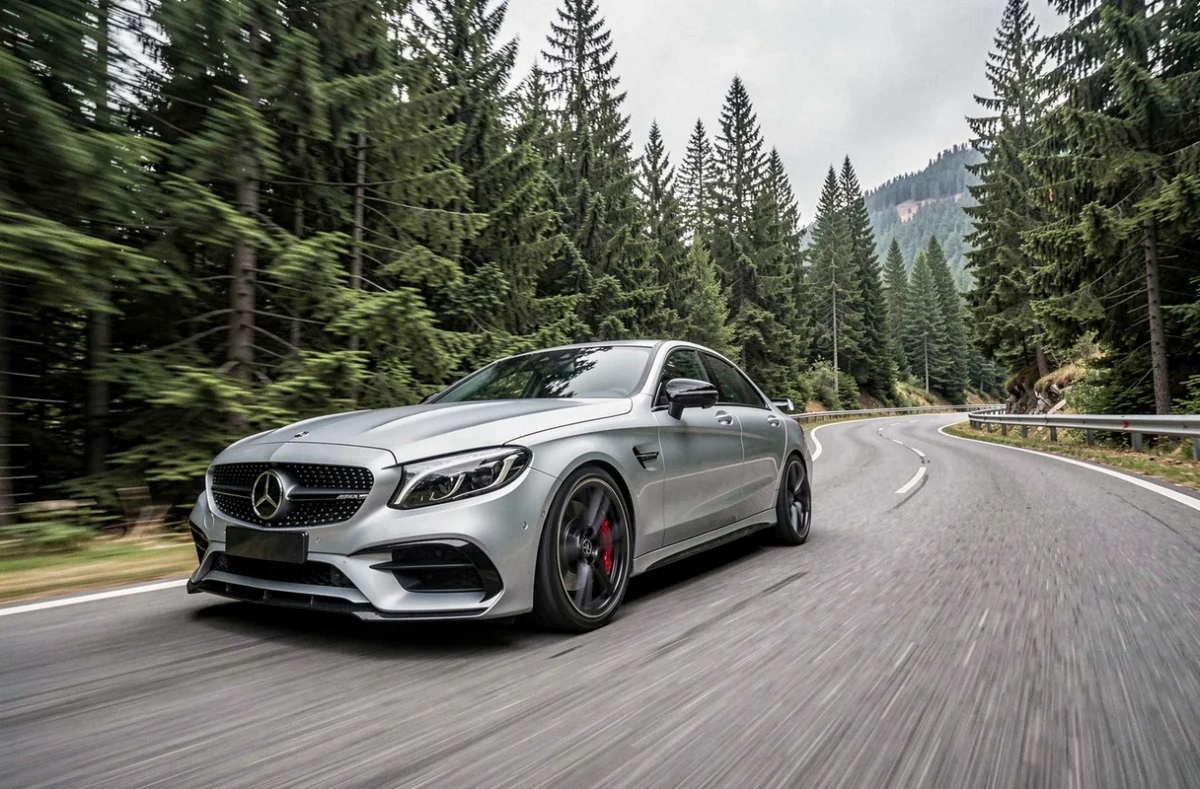
The transition from the V8 to the hybrid four-cylinder on the C 63 has already provoked strong reactions among the brand’s historical customers. The arrival of fully electric models will amplify this debate. Raw power will not be the issue, as electric powertrains offer high torque values from the start. The subject is more about the sensory experience: sound signature, feeling of acceleration, mechanical behavior.
Moreover, customer competition remains an active aspect of AMG’s activities. AMG Customer Racing offers race cars accessible to private drivers, a program that maintains the link between the brand and motorsport. How this program will integrate electric vehicles is not yet specified.
AMG therefore approaches the coming years with a dual imperative: to convince its existing clientele that electrification does not alter the promise of performance, and to attract new buyers for whom thermal prestige is no longer a criterion. The Paris Motor Show in 2026 will provide a first concrete indication of the chosen direction.