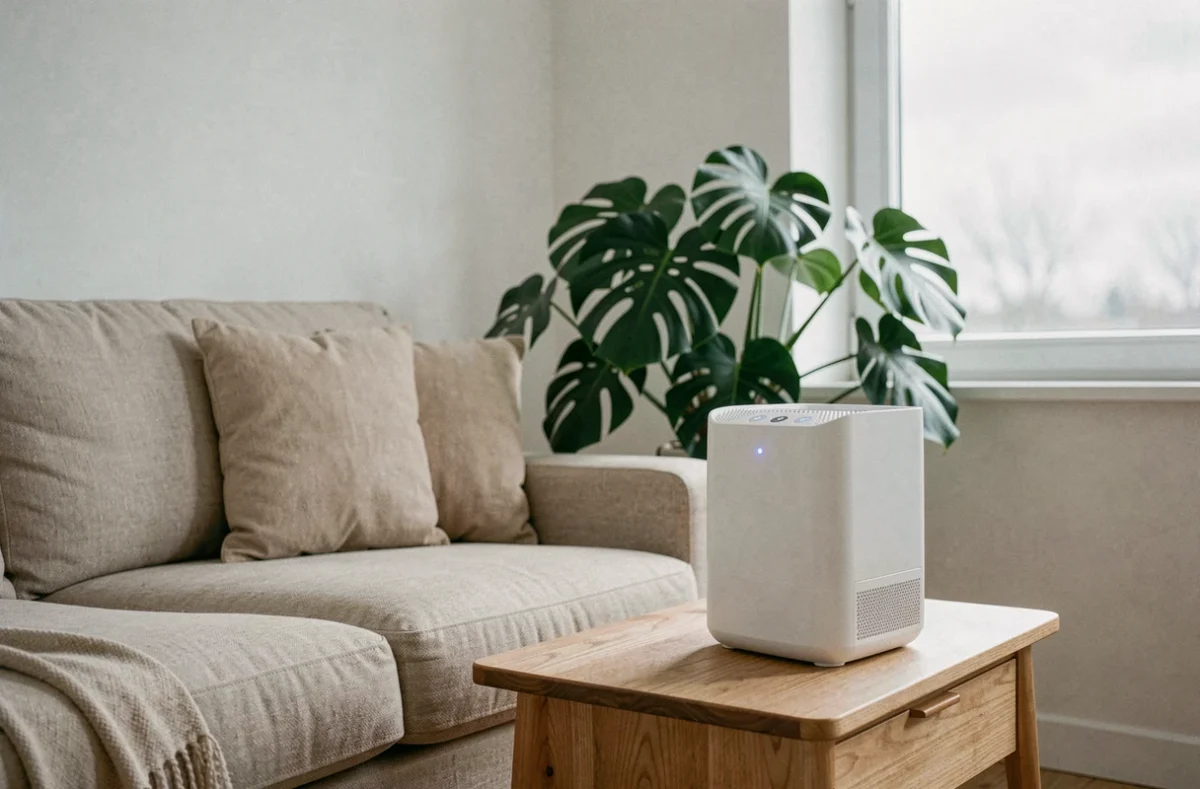
Among the devices available to improve indoor air quality, ionizers occupy a special place: they do not filter air mechanically, but electrically charge airborne particles. Their actual effectiveness, assessed in particular by ANSES in its September 2017 report, remains uncertain. The agency concludes that the available scientific evidence does not demonstrate that ionizers are effective under real-world conditions of use.
Ionizers and fine particles: what the mechanism can actually do
An ionizer generates negative ions that attach to airborne particles (dust, pollen, smoke). Once charged, these particles clump together or settle on nearby surfaces: walls, furniture and floors. The principle relies on electrostatic attraction, not on physically trapping particles in a filter.
According to the EPA, ionizers can remove some small particles from the surrounding air. Their effect on fine particles is therefore real, but limited. The particles are not removed from the room: they migrate to surfaces, which explains the dark marks sometimes seen around devices after several weeks of use.
Available comparative data, also according to the EPA, show that ionizers are less effective than high-efficiency filters at removing dust and pollen. This difference is because a mechanical filter (such as a HEPA filter) captures and retains particles in its fibrous matrix, whereas an ionizer moves them without containing them. For more information on the different air treatment technologies, see this useful resource: https://ioniseurs.fr.

Ionizers, filter air purifiers and ventilation: comparing their effects on gases and odors
The main blind spot of ionizers is gaseous compounds. Negative ions do not eliminate gases or odors, according to EPA data. Volatile organic compounds (VOCs), formaldehyde emitted by new furniture, cooking odors and tobacco smells remain in the air while the device is running.
An air purifier equipped with an activated carbon filter adsorbs some of these gases. A HEPA filter, meanwhile, captures particles only, but does so with a very high retention rate. In terms of versatility, ionizers fall short of both technologies.
How ventilation and source reduction can help
ANSES recommends prioritizing the reduction of indoor pollution sources and ventilating homes. Opening the windows for ten to fifteen minutes a day refreshes the air and removes some of the accumulated VOCs, without using electricity or producing by-products.
Reducing sources means, for example:
- Limiting the use of scented candles, incense and air freshener sprays, which emit fine particles and VOCs
- Choosing low-emission building materials and furniture (A+ label)
- Maintaining mechanical ventilation systems to ensure adequate air exchange
An ionizer is no substitute for any of these measures. It may complement them for particulate matter, but its action covers only part of the range of indoor pollutants.
Ozone and ionizers: an important regulatory limit
Some ionizers produce ozone as a by-product of the electrical discharge that generates the ions. Ozone is an irritant gas that affects the respiratory tract, even at low concentrations.
California regulations, through the California Air Resources Board (CARB), require electronic air treatment devices—a category that includes ionizers—to undergo checks on their ozone emissions. A device’s inclusion on the CARB list means it meets the permitted emissions threshold. However, this certification does not measure the device’s purification performance. A CARB-certified ionizer emits little ozone, but that does not guarantee it purifies the air effectively.
This distinction is often missing from product descriptions. Consumers who see the words “CARB compliant” may reasonably assume that purification performance has been verified, when only ozone emissions have been assessed.
Ionizers and asthma: what available clinical trials show
One recurring marketing claim links ionizers with relief from respiratory symptoms. The available clinical evidence does not support this claim.
A Cochrane review of six crossover trials involving 106 participants found no significant difference between negative-ion ionizers and sham devices. The outcomes measured included breathing, asthma symptoms and the use of bronchodilators. The review does not support recommending ionizers to reduce chronic asthma symptoms.
These findings do not mean that ionizers make asthma worse. They indicate that the evidence of benefit is too limited to draw a conclusion. The trials analyzed involved small samples, which limits the statistical power of the results.
What to check before buying an ionizer
Given these documented limitations, there are a few points worth checking before making a purchase:
- Whether it has CARB or equivalent certification confirming that ozone emissions are controlled
- The coverage area stated by the manufacturer, compared with the room in question
- Whether it includes a mechanical filter, which would offset the limitations of ionization alone when it comes to gases and larger particles
- The noise level during continuous operation, which is rarely specified but important for nighttime use
An ionizer combined with a HEPA filter in the same device offers a broader range of action than an ionizer alone. Ionization alone does not remove gases, odors or larger particles as effectively as a mechanical filter.
The current state of knowledge, as summarized by ANSES and the EPA, places ionizers in the category of supplementary devices rather than primary solutions. Ventilating, reducing pollution sources and, if you want a device, choosing a mechanical filtration air purifier remain the best-documented approaches to improving indoor air quality.