Buying a top or pants online when you wear XXL often means ordering two sizes to return one. The problem does not stem from body shape, but from a persistent ambiguity between French size charts, international letters, and the actual measurements of clothing.
Discrepancy between the XXL label and the actual garment measurements
We expect an XXL to correspond to the same centimeters everywhere. In practice, the fit of an XXL varies significantly from one brand to another. UFC-Que Choisir measured women’s jeans and noted significant differences between the waist measurement stated on the label and that of the garment laid flat.
This discrepancy is explained by the absence of a binding standard in Europe regarding the measurements associated with each letter. Each brand creates its own size chart based on its in-house patterns. Therefore, two garments labeled XXL can have several centimeters of difference in bust or hip measurements.
To limit errors, it is better to rely on the specific measurement charts of each site rather than the letter alone. Reliable information on the correspondence of women’s size XXL is based on three measurements taken directly on the body: bust, waist, and hip measurements.
Women’s size XXL: French and international correspondence chart
A women’s XXL generally corresponds to a size 46 or 48 in most French size charts. Depending on the brands, the range can shift to 44-46 or 48-50. The table below summarizes the most common equivalences.
| Letter size | FR size | Bust measurement (cm) | Waist measurement (cm) | Hip measurement (cm) |
|---|---|---|---|---|
| XL | 42-44 | 100-104 | 80-84 | 106-110 |
| XXL | 46-48 | 105-112 | 85-92 | 111-118 |
| 3XL | 50-52 | 113-120 | 93-100 | 119-126 |
Returns vary on this point, as some brands shift their size chart up or down. At O’Neill, for example, a women’s XL covers a bust measurement of 100 to 104 cm and a waist measurement of 80 to 84 cm, which already corresponds to a French 42-44.

For pants, the inseam measurement is added, expressed in centimeters or inches. This data is often missing from generic size guides, even though it directly affects the length of the garment worn.
Taking measurements accurately: practical method
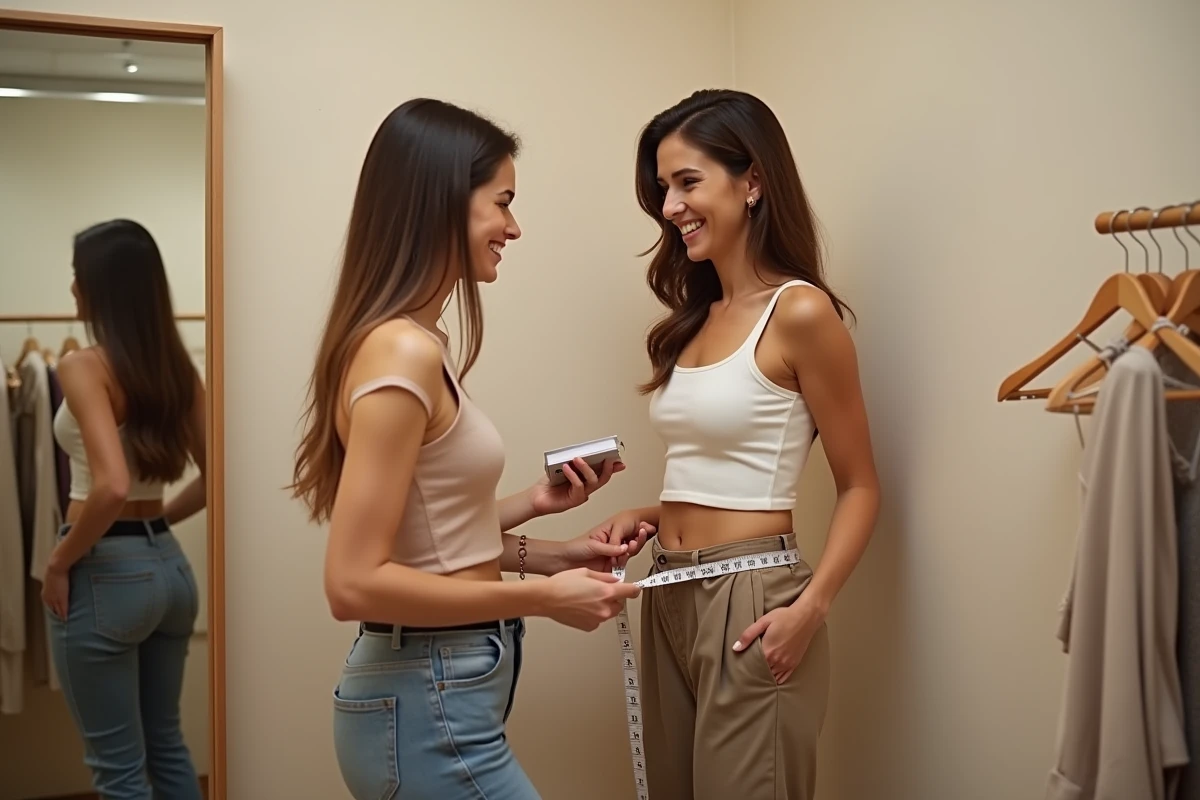
A flexible measuring tape, a mirror, and two minutes are enough. Measure directly on the skin or over a thin undergarment, without tightening or leaving slack.
- Bust measurement: run the tape around the fullest part of the bust, under the arms, keeping the back straight.
- Waist measurement: measure at the natural waist indentation, generally two fingers above the navel. Do not suck in your stomach.
- Hip measurement (pelvis): place the tape on the widest part of the hips, including the buttocks.
- Inseam: measure from the crotch to the ankle, standing with feet slightly apart.
Record your measurements in centimeters, then compare them to the target brand’s chart. When you fall between two sizes, it is better to choose the larger one, especially for structured garments (jackets, blazers, rigid jeans).
Special case of tops and dresses
For a top, the bust measurement takes precedence. For a fitted dress, it is the hip measurement that determines the size. Choose based on the largest measurement to avoid a garment that pulls at the seams.
Women’s size XXL on American and British sites
Transatlantic equivalences add a layer of complexity. On an American site, women’s size XXL generally corresponds to a US 18-20. On a British site, it refers to a UK 22-24. These numbers are not interchangeable with the French size chart.
In US sizing, the system uses even numbers (2, 4, 6, 8, etc.) that do not correspond to centimeters or French sizes. A French 46 is approximately equivalent to a US 16-18, but this correspondence fluctuates from brand to brand.
For purchases on foreign sites, always refer to the size guide in centimeters published by the seller. If the site only displays letters or numerical sizes without measurements, it is a warning sign: the probability of error increases.
XXL is no longer an end-of-chart size
For a long time, XXL marked the upper limit of collections. That time is receding. H&M is gradually expanding its plus-size offering in physical stores across several European markets, whereas these sizes were previously reserved for the online site. C&A is integrating its plus-size line into more retail locations, with size charts going up to 3XL or 4XL.
This shift makes XXL a common size rather than an exceptional one. The practical consequence: the offering expands, fits improve, and returns related to poor fit decrease when brands genuinely invest in the patterning of these sizes.
Before finalizing a cart, check three things: your own up-to-date measurements, the brand’s chart (not a generic chart found elsewhere), and the return policy. A well-fitted garment in XXL lasts as long as an M or L, provided you have chosen it with the right numbers in hand.